I'll start from the end, a discount (if any) will be given only on the cost of packaging materials.
Why?
For the most part labor cost components do not change at all.
Clients who come to me with this question are usually trying to cut costs.
Of course, transportation costs can be thousands of dollars or more and we'd all love to save costs.
It is important to state up front, an International move is completely different than a local move.
Naturally, an international move includes many parameters in the equation of added risk.
For example; loading and unloading contents more than once, transferring the container from one vehicle to another or to a train or onto a vessel, use of the crane at the port and other operational aspects that may cause your household goods to be damaged.
Therefore, professional packaging, done by highly skilled teams is preferable in most cases to maintain and protect your possessions, especially when compared to self-packaging.
No one would want to get his shipping carton crushed, torn or cut
.
As part of that effort, a trained packer will adapt packaging material to pack and protect (carton certain size, thickness, Dupont corners of furniture, etc.).
Even the location of each object in a carton has a meaning and consequently also the location of cartons inside the container.
Of course, a professional packing team from shipping company arrives with new export quality packaging materials.
Another aspect worth considering is cargo insurance depending on the packing (independent versus professional).
There are two main types of insurance; "Total loss " or "all risks".
“Total Loss” insurance is the cheapest of the two.
This insurance will cover only the full loss of the entire shipment (fell into the sea, lost etc.).
"All risk" Insurance cover almost any type of damage - including even a single item in the shipment – this is the most common coverage in household moves.
Insurance companies that issue marine policies for household goods, will generally not insure client packed boxes with "all risk” insurance.
“All risk” insurance is issued only for goods that have been professionally packed, by shipping companies.
To sum up, sending the contents of your home across the ocean? It is recommended to require professional packaging by a recognized and well established company in the field.
Such packaging will ensure the arrival of your belongings intact and as close to their original condition as possible and allow comprehensive insurance coverage…just in case ..
Tuesday, May 19, 2015

Tuesday, April 7, 2015
Shipping From Israel to the United States
Few adventures match the stress of moving around the world.
The excitement of starting a new life in the United States can compensate for the myriad details that go in to moving from Israel to the United States.
The excitement of starting a new life in the United States can compensate for the myriad details that go in to moving from Israel to the United States.
While Israel offers many opportunities for advancement and success, the United States by virtue of its vast size and openness oftentimes presents opportunities that will allow one to make an even better contribution to Israel upon one’s return.
Of course, when moving, it is important to find a shipping company that will provide you with a complete door to door move.
This means the moving company will send a packing crew to pack all your goods.
After packing your things, they will make a numbered packing list and give you a copy for your records.
This means the moving company will send a packing crew to pack all your goods.
After packing your things, they will make a numbered packing list and give you a copy for your records.
When your shipment arrives in the United States, you will use this same packing list to check off all your boxes to make sure all has been safely delivered.
If you see any damage during delivery, you should make a note next to the number of the box or item that was damaged.
If you see any damage during delivery, you should make a note next to the number of the box or item that was damaged.
This will help when filing a claim with your insurance company at a later date if necessary.
After you finish unpacking, you will hopefully be able to look back on an experience that could have been stressful, but because you picked a moving company that cared about you and for you, was not stressful at all.
Sunday, January 25, 2015
International Shipping – Why is the cost of international shipping for Household Goods higher than for international shipping of commercial goods?
When it comes time to get pricing for international shipping, one of the first questions most international shipping companies will ask is “What is the commodity” or “Are you shipping Household goods and Moving, or is this commercial”.
There are many reasons for this, and all of them have an effect on the cost.
There are many reasons for this, and all of them have an effect on the cost.
First and foremost, not all companies know how to deal with Household Goods.
Not only are there usually special requirements for packing and loading the container (something which is almost NEVER done for international shipments of commercial goods); The procedures for customs release are different; the rules for what can be shipped as Household Goods are different; and the services required in the destination country (such as sending a crew to unload the goods into a home and unwrap furniture) are different.
As such, these extra services require the use of companies that are capable of packing and wrapping; loading into a container or wooden crates; and unloading the container into a home.
Most international shipping jobs of commercial goods require NONE of these services.
Not only are there usually special requirements for packing and loading the container (something which is almost NEVER done for international shipments of commercial goods); The procedures for customs release are different; the rules for what can be shipped as Household Goods are different; and the services required in the destination country (such as sending a crew to unload the goods into a home and unwrap furniture) are different.
As such, these extra services require the use of companies that are capable of packing and wrapping; loading into a container or wooden crates; and unloading the container into a home.
Most international shipping jobs of commercial goods require NONE of these services.
Of course, most homes don’t have a loading dock capable of parking a truck the size which is often required for international shipping.
Next, the cost of Ocean Freight for international shipping is based on the commodity being shipped.
It is pretty obvious why a shipment of dangerous goods would be more expensive than a shipment of non-dangerous goods; however it may not be so clear that a shipment of new washing machines for resale would cost less than a shipment of used household goods for personal use.
The reasons why this is aren't important – the fact is that Household Goods are always the highest price for ocean freight.
(Household goods are also the lowest priority for ship lines as far as loading order).
It is pretty obvious why a shipment of dangerous goods would be more expensive than a shipment of non-dangerous goods; however it may not be so clear that a shipment of new washing machines for resale would cost less than a shipment of used household goods for personal use.
The reasons why this is aren't important – the fact is that Household Goods are always the highest price for ocean freight.
(Household goods are also the lowest priority for ship lines as far as loading order).
Another reason that international shipping of Household Goods is more expensive is simply that most people who ship Household Goods require more time and attention from the shipping company involved.
The typical commercial shipper knows how to fill out the forms, and in many countries the process for release of commercial goods is simplified.
The typical commercial shipper knows how to fill out the forms, and in many countries the process for release of commercial goods is simplified.
As you can see, even in the event that you plan on packing and loading the container yourself and unloading and unpacking the container yourself at destination, the costs will still be more than your neighborhood factory who is shipping the same size container of new clothing for resale to the same destination.
Sunday, November 10, 2013
Picking an Israeli Moving Company
When
moving from Israel to a foreign country, many tasks await you.
From closing utilities accounts to handling insurance transition from Israel to your new home and handling schools for your children, picking a mover is but one of many.
From closing utilities accounts to handling insurance transition from Israel to your new home and handling schools for your children, picking a mover is but one of many.
This
article will help you pick a mover who will do a good job for and
hopefully give you no surprises.
Choosing a mover in Israel is very similar to choosing a mover anywhere in the world.
Choosing a mover in Israel is very similar to choosing a mover anywhere in the world.
First,
get recommendations from friends who have recently moved.
If these friends moved to the same place you are moving – all the better.
Each destination country has its own idiosyncrasies and a removal company who specializes in your country is a clear advantage.
A company with experience to your destination will be able to advise and direct you what to avoid and to declare in order to minimize or eliminate taxes.
An experienced moving company will also know the required paperwork at destination so you can prepare these documents in advance.
If these friends moved to the same place you are moving – all the better.
Each destination country has its own idiosyncrasies and a removal company who specializes in your country is a clear advantage.
A company with experience to your destination will be able to advise and direct you what to avoid and to declare in order to minimize or eliminate taxes.
An experienced moving company will also know the required paperwork at destination so you can prepare these documents in advance.
After
assembling a list of 2 – 4 recommended moving companies, invite them to
your house to perform a pre-move survey.
During this survey, the company’s representative will get a tour of your home while you tell him what is going and what is staying.
At the same time, you should take advantage of this time to determine the surveyor’s professionalism and knowledge.
While the surveyor will not be packing or loading your container, as the company’s representative you have a chance to learn what you can expect from his or her company.
During this survey, the company’s representative will get a tour of your home while you tell him what is going and what is staying.
At the same time, you should take advantage of this time to determine the surveyor’s professionalism and knowledge.
While the surveyor will not be packing or loading your container, as the company’s representative you have a chance to learn what you can expect from his or her company.
After
the survey, you can expect to receive a quote.
When studying the quotes you receive, make sure you are comparing oranges to oranges.
Are all companies offering the same service? Are all companies including the same costs? Study the “not included” section very closely.
Is there anything there that you will definitely have to pay? Ask your sales person.
If the answer is yes, this should be a red flag.
Any cost you definitely have to pay, should be stated and listed up front and not hidden in the “Not Included.” Section.
When studying the quotes you receive, make sure you are comparing oranges to oranges.
Are all companies offering the same service? Are all companies including the same costs? Study the “not included” section very closely.
Is there anything there that you will definitely have to pay? Ask your sales person.
If the answer is yes, this should be a red flag.
Any cost you definitely have to pay, should be stated and listed up front and not hidden in the “Not Included.” Section.
Once
you know the price, add in the reputation of the company, your friends’
recommendations, and your impression of the company / surveyor.
With this information, you should be able to make a well informed and thought out decision.
With this information, you should be able to make a well informed and thought out decision.
Safe travels.
Monday, August 26, 2013
Down That Way
Traveling to an international conference from Israel always involves many hours of flights, something I have become used to.
However,
my first trip to India on two weeks’ notice was unusually special.
Sonigo Shipping was newly accepted to FIDI and when David Sonigo said “Go to the conference”, I didn’t ask questions, I just started looking for flight and hotel reservations.
Sonigo Shipping was newly accepted to FIDI and when David Sonigo said “Go to the conference”, I didn’t ask questions, I just started looking for flight and hotel reservations.
When
I could not find a hotel reservation, I should have understood, this
was not meant to be. However, I did find a great business class fare
that was cheaper than flying coach on El Al, so I was off.
Or
so I thought…I flew charter to Istanbul where I was to catch my
business class flight to New Delhi. After disembarking in Istanbul, I
started asking where is the Air India desk. When little English is
spoken, hand gestures sufficed to point me “down that way.” When I got
to “down that way” I asked again and was pointed even father “down that
way.”
When
I go to the exit of the terminal and still had not found the Air India
desk, I assumed I had simply missed it. At this point I met my first
English speaker who explained, “down that way” was 75 kilometers away at
Istanbul’s other airport!!
After
an excruciatingly long taxi ride, I surprisingly (to me anyway) made it
to the Air India desk where my flight was waiting for me.
Even with cab fare, it was still cheaper than El Al!
Tuesday, July 2, 2013
Barbra Streisand Tel Aviv 2013
Barbara Streisand ended her World Tour in Tel Aviv, Israel on 23 June with the 100th live performance of her career.

Sonigo International Shipping handled the household moves to Israel of some 40 tons of air cargo.
Besides clearing the shipment under ATA Carnet, Sonigo unloaded the plane and loaded the trucks which brought the equipment to the Bloomfield Stadium in Tel Aviv. Sonigo’s crews then unloaded the equipment used for the staging, lighting and sound equipment.
After her performance, Sonigo’s crews packed her equipment, sending some 10 tons by air cargo and loading the rest in two 40 foot containers.
According
to General Manager David Sonigo, “Timing is everything in show
business. We cannot permit any delays and the planning of an operation
like this requires us to plan for and accommodate contingencies…because
if something can happen – it usually does! At the same time, the
performance must start on time and we guarantee it.”
“Of course, household moves to Israel are our core business, but our crews love the extra hours working in show business.”
Established
in 1986, Sonigo Shipping with some 60 team members, provides shipping
and moving services to thousands of families a year.
Monday, June 24, 2013
Importing
Starting
a new business based on importing items from overseas seems so easy –
after all everything seems so cheap in America, or China or almost any
place else – besides Israel!
This
might be right, but then again, it might not be. Your in-depth
analysis of whether a business is worth it or not is critical when
deciding about any business and importing is no different.
First,
only a business entity can import a commercial quantity of goods. Up
to two items can be considered personal import. More than two is a
commercial quantity and you must be a business, with VAT id to import
these goods.
Second,
you must determine if permits are required for the product you want to
import. Most food and heath items require permits. All electric items
that plug into an outlet require a permit from the Standards Institute.
A
licensed customs broker can help you determine what permits you need,
although in most cases you should investigate on your own. Unless the
customs broker has extensive experience with your line of products, he
or she may not know the best way to categorize your products and your
own investigation will contribute to your saving money on taxes and time
with permits.
Every product has an HS code
(Harmonized System). The HS code is an internationally accepted coding
system used by Customs. Asking your supplier for the HS code will save
you time and effort in determining the item’s tax rate and if permits
are required.
Most
finished goods are taxed at 12%, while most raw materials are taxed at
8%. If goods are made and imported from a country with a “free trade”
with Israel, you will need to supply the appropriate Certificate of
Origin and then you will be exempt of the 8% - 12% Customs Duties
mentioned above. There is no exemption from VAT (currently 18%),
although as a business, this does not really cost you as it is a pass
through tax.
So
far, we have discussed taxes and permits…the next step in determining
the viability of an import business will revolve around the cost of
shipping. You can buy goods from your supplier, including shipping to
your door, although this is very rare. In most cases you will buy with
FOB or EXW terms.
FOB
means Free on Board and means the supplier is responsible for
delivering the goods to the port or your shipper’s warehouse and taking
care of export customs formalities. You will be responsible for shipping
from the port to the final destination.
EXW
means Ex Works and means you are responsible for picking up the goods
at your supplier’s warehouse and all shipping costs to the final
destination.
If
you are in a hurry to get your product, you will consider air cargo.
While very expensive, it is also very quick. With light weight and
compact products, this may be the most economical way to ship. When
considering small air shipments, courier (such as DHL, UPS or Fedex) is
often the best way to ship as they will provide door to door service.
You
might also consider the Postal Service’s Express Mail service, although
this will take 2 – 4 days longer than the private courier service. The
best advantage with Express Mail is they usually do not take into
account volume which considerably increases the cost with the private
courier service. This policy can change so you will want to verify this
when you are ready to ship.
If
the shipment is larger, then you will probably ship via air cargo.
When considering air cargo, you must verify the maximum pallet size
that will fit in the plane. Different planes have different loading
capacities. You don’t want your shipment delayed until the plane with
the right size cargo hold flies on your lane.
Air
shipment charges are based on weight with a minimum charge of 10 lbs to
the cubic foot (or 167 kgs to the cubic meter.) This means a bulky
light weight item will be very expensive to ship via air.
Ocean
shipments take longer and are significantly cheaper than air shipments.
An ocean shipment can be via an exclusive container, called an FCL (Full Container Load). FCLs come in three sizes – 20 foot, 40 foot and 40 foot “High Cube” which is one foot higher.
If
you have less than a full container, you will probably ship your goods
as an LCL (Less than Container Load). In this case you will pay by
volume – either per cubic foot or per cubic meter. In rare cases where
you ship heavy items such as printed goods or stone, your charge will be
based on the rate of 1 ton being charged at the rate of 1 cubic meter.
Your forwarder will handle all shipping arrangements.
In
either case, air or sea shipment, you will need a licensed Customs
Broker to clear your goods through Customs. Most brokers have
representatives at the airport (Ben Gurion) and the sea ports (Ashdod,
Eilat and Haifa). Once cleared, you or your forwarder will arrange
delivery of the goods from the port to your warehouse. You will want to
do this as quickly as possible to avoid or at least limit expensive
port storage fees.
This
brief outline gives you a few pointers to help make your business a
success, but obviously there is much more to learn and check before
making the decision to start an import business. You must prepare
profit and loss and cash flow projections (don’t forget the VAT payment
required to clear your goods through Customs – an outlay long before you
have any income.)
These projections will include all your operating expenses. Remember, your salary is one of those important expenses as well.
With a lot of hard work, long hours, much Siyatta Dishmaya, BE”H, you can make a business succeed in Israel.
Saturday, June 22, 2013
Moving to Israel
Moving to Israel, like moving to anyplace in the world can be a stressful experience.
Sonigo
International Shipping makes every effort to make moving to Israel or
moving from Israel as smooth and hassle free as possible.
Of course, this is not always possible.
Children and pets make any move more complicated because they must also be taken care of while movers are packing up your goods for your move overseas.
Of course, this is not always possible.
Children and pets make any move more complicated because they must also be taken care of while movers are packing up your goods for your move overseas.
Moving
pets requires various veterinary permits from the departing country to
the arrival country.
It is very important to check this and verify all requirements before you move to Israel.
It is very important to check this and verify all requirements before you move to Israel.
Children
will become tense and worried about leaving friends and making new
friends.
Finding the right school in your new home and then enrolling your children will add to your arrival responsibilities at your destination.
Finding the right school in your new home and then enrolling your children will add to your arrival responsibilities at your destination.
Hopefully,
your moving company in Israel will help smooth out any issues that may
occur with Customs in clearing your shipment.
When you move from Israel, your mover will also have to verify any potential issues with Customs.
Handling export customs formalities should be something you are not involved with unless there is a problem that requires your intervention.
As a licensed Customs Broker, Sonigo can make all necessary arrangements with Israeli Customs so you can take care of getting your new home set in Israel or the Unites States, England, France or anyplace you are moving to.
When you move from Israel, your mover will also have to verify any potential issues with Customs.
Handling export customs formalities should be something you are not involved with unless there is a problem that requires your intervention.
As a licensed Customs Broker, Sonigo can make all necessary arrangements with Israeli Customs so you can take care of getting your new home set in Israel or the Unites States, England, France or anyplace you are moving to.
Tuesday, June 18, 2013
Sonigo Compliance from FIDI
Sonigo has just been awarded a Complete Compliance from FIDI, the leading organization of International Moving Agents.
Ernst
and Young performed a full day audit of the Sonigo’s equipment, packing
material, licensing, financials.
This audit is a required preliminary to being accepted into FIDI.
This audit is a required preliminary to being accepted into FIDI.
At
the end of the audit, the Ernst and Young auditor informed the Sonigo
team that this was the first time, she had awarded a perfect 100 score.
While
FIDI membership symbolizes the elite of the moving industry, Sonigo
continues to search new and innovative ways to help their clients move to Israel.
Thursday, May 23, 2013
Containers Overboard!
Containers Overboard!
Israel was rocked by a tremendous storm over a 6 day period that intermittently shut down the ports as strong winds buffeted the area.
On 10 January, the last day of the storm, strong winds again shut down the port. As per protocol, vessels in port were towed out to sea to ride out the storm. While being towed out to sea, the Zim Constanza was hit by a huge wave knocking 26 containers overboard including two containers belonging to our clients.
One FCL and one groupage container with 3 clients including a brand new 2013 Mustang were our casualties.
Even though our weekend had started, Meirav Azulai, Import Manager, went to the office to pull the files and immediately update the insurance company. She forwarded them the relevant documents so they could begin the claim process.
As shown in the pictures about eight containers were washed up on a sea wall including our groupage container. Our FCL remains underwater and may never be recovered.
Besides the heartache of lost and irreplaceable memorabilia, all our clients were fully insured including coverage of the cost of shipping. The insurance company and their appraisers are working on these claims while we have made every effort to keep our clients informed of any new development.
While this is thankfully, an extremely rare event, we have remained in constant contact with our clients offering words of support as we help expedite completion of the insurance process.


Thursday, May 9, 2013
When the Mover Moves
Who knows better than a mover, how stressful a move can be? Sonigo (Israel) International Shipping knows better than most.

After 6 years at
their last warehouse and office, they shut down all computers, servers and
switchboard at 2 pm on 20 December 2012 and moved to a beautiful, new facility
3 kilometers away. This followed two
weeks of massive transit of some 350 storage containers and vaults. 87 trips by flat-bed trucks and 36 trips by
closed trucks moved Sonigo to their new facility.

Most important, according to David Sonigo, our mail server was back up by 6:30 pm on 20 December. “We knew there would be down time when we disconnected our switchboard and all our computers and we prepared as much in advance as possible…but I never believed we would be back on line within 4 hours.”
Sharon Raz-El, Deputy
General Manager, oversaw the logistics of this massive move of people,
equipment and stored goods that occupied some 4000 square meters. Even though the new facility is only two
years old and has some of the newest state of the art equipment, there was
still a tremendous amount of planning, building and refurbishing required to
bring everything up to Sonigo’s standards.
Sonigo said, “We are
completely back to work and making efforts to fill our books for the
summer. We are building new strategic
alliances with the best and most experienced moving and relocation companies in
the world. At the same time, we continue
to explore the latest techniques and technologies that will allow us to provide
a smoother, safer and stress free move for our clients.
“Our new facility
makes these efforts even easier for us and nobody knows better than us…moving
is a stressful business.”
Sonigo International
Moving, established in 1986, employees some 60 full time staff, specializes in
household goods shipping and concert project logistic management.
Tuesday, January 22, 2013
The Ashdod Customs House has decided to inspect any import shipment with
a bicycle, to ensure that the bicycle is not motorized.

Motorized bicycles require approval from Ministry of transportation.
Charges for the inspection are billed to the owner of the goods.
This only affects shipments arriving to Ashdod (for now).
We are working with other licensed customs clearers to get this rule revoked (even if only for Olim Hadashim and Toshvim Hozerim); however right now it is best to NOT import a bicycle of any sort.

Motorized bicycles require approval from Ministry of transportation.
Charges for the inspection are billed to the owner of the goods.
This only affects shipments arriving to Ashdod (for now).
We are working with other licensed customs clearers to get this rule revoked (even if only for Olim Hadashim and Toshvim Hozerim); however right now it is best to NOT import a bicycle of any sort.
Tuesday, January 15, 2013
Israeli Customs is now requiring a "Teken" (Approval from Ministry of
Standards) or a "Ptor" (Exemption from the approval) for ALL gas grills
(Bar-b-ques) imported, even as personal import.
Any import shipment containing a gas grill will be pulled for inspection, and the grill will be held by customs until the approval or exemption is issued.

Of course, charges for the inspection/ removal, and storage of the gas grill will be billed to the owner of the goods.
We are working with other licensed customs clearers to get this rule revoked (even if only for Olim Hadashim and Toshvim Hozerim); however right now it is best to NOT import a gas bar-b-que.
Any import shipment containing a gas grill will be pulled for inspection, and the grill will be held by customs until the approval or exemption is issued.

Of course, charges for the inspection/ removal, and storage of the gas grill will be billed to the owner of the goods.
We are working with other licensed customs clearers to get this rule revoked (even if only for Olim Hadashim and Toshvim Hozerim); however right now it is best to NOT import a gas bar-b-que.
Tuesday, January 1, 2013
US Longshoreman's strike
The US Longshoreman's union has agreed to a temporary extension of their
contract.
This averted a strike, which would have affected all East Coast US Ports (including the Gulf of Mexico). The extension is until 28 January, and the threat of a strike at that time still remains.

This averted a strike, which would have affected all East Coast US Ports (including the Gulf of Mexico). The extension is until 28 January, and the threat of a strike at that time still remains.
Sunday, September 2, 2012
Improved Customs Rights for New Immigrants
Improved Customs Rights for New Immigrants (Olim Hadashim) and Returning residents (Toshavim Hozerim)
The following items, which were not previously exempt from taxes, are now tax exempt (for Olim and Toshvim Hozrim):
· Indoor exercise equipment (Treadmills, Exercise Bicycles)
· Camping Equipment
· One each of small household electronics
· Two Air Conditioners
· Television Games (x-Box, etc…)
· One Fax Machine
· Outdoor (Garden) Furniture / Patio Swings
Please note: The following items are not tax exempt and are still taxable:
· Outdoor goods, like storage sheds, swimming pools, etc.
· Garbage disposals.
Changes in Toshvim Hozrim Rights and Status
Toshavim Hozerim who arrive in Israel on or after 1 October 2012, will no longer receive a discount for importing or buying a new car.
As of 1 October 2012, there will only be one status for Toshavim Hozerim who return after more than 2 years with rights similar to olim chadashim with the following differences:
· Two shipments of household goods can be imported within 9 months of arrival in Israel
· No discount on taxes for vehicle.
Tuesday, June 19, 2012
Key to Success Found near Bethlehem
Most business people search for the “key to success”
throughout their career.
Sonigo International inIsrael
may have finally found the key…
Sonigo International in
Built in 2008 just outside Bethlehem in the Palestinian Authority, the
pictured key weighing nearly one ton is almost 9 meters in length.
When the 7thBerlin
Biennale wanted to include the key in their exhibition, they turned to
Sonigo to “remove” the key from its display position at the town entrance,
truck it to Sonigo’s carpentry shop and crating facility and from there to port for
shipping to Berlin .
When the 7th

Key to Success
The 1 ton key is being lowered onto the flatbed as many “assistants” help direct the loading operation.
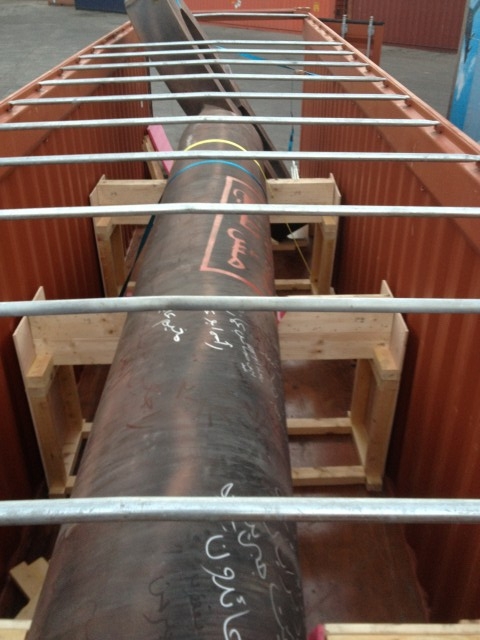
Key in Cradel
The key is lashed into place in the open top container into the purpose built cradle.

Removing Key from Arch
The delicate and complicated operation of dismantling the key from the arch at the town entrance required 2 heavy cranes.
According to David
Sonigo , Managing Director, “we have done many special and
unusual projects over the years, but this was one of the most
interesting.”
Coordinating the key’s removal from its display stand12
meters high, lowering it by crane onto the truck into
the purpose built cradle, particularly satisfying.
Coordinating the key’s removal from its display stand
Sonigo continued, “Although our principle business is
personal effects and house hold goods, a special project like this is a great
challenge to our crews and an opportunity to show how we can exceed
expectations.”
After crating and lashing in place, the key was moved to the
port where it was shipped to POE Bremerhaven.
At the end of the Exhibition in Berlin , Sonigo is looking forward to
bringing the key back home and returning it to the top of arch at the entrance
to town.
Sonigo concluded with, “After seeing this magnificent key
and what it represents, I can only hope this key to success will be the key to peace and allow me
to meet with my agents in Lebanon
and throughout the Arab world and share a good cup of Arabic coffee.”
Tuesday, June 12, 2012
Madonna in Israel - MDNA tour (By Sonigo)
Equipment for MDNA tour
Some of the 1400 tons of equipment imported for Madonna’s
first concert on her MDNA World Tour. Note the heavy duty aluminum portable
flooring protecting the grass. Designed to handle landing jetliners, Sonigo’s
semi-trailers were easy to handle.

Building Madonna Stage
Raising the 45 ton roof of the stage for Madonna’s concert
was a study in artful technology. It took over 6 hours to raise and then the
riggers and lighting specialists went to work hooking everything into the
system that produced a magnificent spectacle for over 33,000 fans.

Monday, June 11, 2012
INFORMATION CONCERNING CAR SHIPPING TO ISRAEL
INFORMATION CONCERNING CAR SHIPPING TO ISRAEL
Prior to shipping a car to Israel, you must check if the car is approved by
the official importer or authorized garage in Israel.
We recommend you forward the following documents to our local representative in Israel, Mr. Sonigo:
We recommend you forward the following documents to our local representative in Israel, Mr. Sonigo:
FOR "OLIM" (IMMIGRANTS) and
"TOSHAVIM
HOZERIM" (RETURNING
CITIZENS)**
- A copy of your foreign and/or Israeli passport
- A copy of your car driver's license (Foreign and/or Israeli)
- A copy of your car title
- The car bill of sale or invoice (Please provide the exact date of the car manufacture and country of manufacture as well)
After receiving the above documents, we
will be able to offer you an estimate of the duties and taxes you will have to
pay for your car import.
**PLEASE
NOTE For "Toshavim Hozerim"
ONLY: the date of the car manufacture (not the date of the car registration)
must be less than 4 years upon vehicule arrival to Israel.
Tuesday, August 30, 2011
Later Aliya Planning
- Schools
- Shipping
- Finding a Place to Live
- Bringing Your Pet
- Bring a Car on Aliya
- Finding a Job
Monday, August 15, 2011
Aliya: Split Aliya, Special Needs
Sometimes it is necessary for spouses to make Aliya at different times, due to employment needs, or other personal reasons.
While it is not usually preferable, it is possible.
It is very important that all people or companies involved in your Aliya Process (The Jewish Agency, NBN, your Shipping Company, your accountant) be aware that you are making a split Aliya, so that there are no problems or delays once you are in Israel.
Special Needs
If you or one of your family members have special needs, be sure to let the Jewish Agency, NBN, and any other organization you are working with know about them in advance.
Sometimes it makes sense to hire a private agency to help with your pre and post-Aliya plans.
For more information contact:
- Aliya121
www.aliyah121.com
Subscribe to:
Posts (Atom)